Sense and Sensibilities of TP Methods, Workshop Singapore, 28 August 2017
Home • Events • Sense and Sensibilities of TP Methods, Workshop Singapore, 28 August 2017
Home • Events • Sense and Sensibilities of TP Methods, Workshop Singapore, 28 August 2017
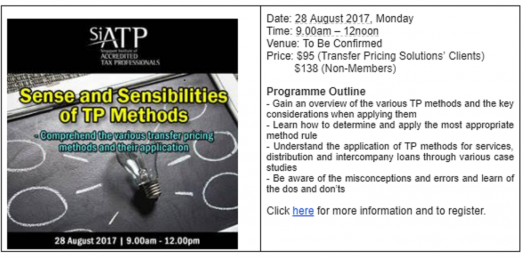
With transfer pricing being increasingly scrutinised, an area that companies and tax authorities may disagree is the correct application of the selected transfer pricing (TP) method. When challenged, companies have to demonstrate why and how the specific method was adopted.
In this session, Ms. Adriana Calderon, our director at Transfer Pricing Solutions Asia will share practical insights on the five common TP methods recognised by the OECD through various case studies.
Register for this session organised by the Singapore Institute of Accredited Tax Professionals and learn key tips to determine and apply the TP method that best suit the type of related party transaction.
Secure your seat NOW! The registration is open until 21 August 2017. A special discount applies to members of SIATP, ISCA, SICC, SMF and TPS Clients.
To register visit https://tinyurl.com/siatpevent-tp-methods.
For further enquiries about the event, please visit www.siatp.org.sg/events, contact Darrick at 6597 5719 / Nabila at 6597 5714 or email to enquiry@siatp.org.sg.Adriana Calderon shares her perspective on the evolving tax landscape and the role of collaboration at the SCTP Singapore Tax Congress.
The Inland Revenue Authority of Singapore (IRAS) has updated its Frequently Asked Questions relating to the Reporting of Related Party Transactions (RPT Form), providing additional clarification on the scope of entities and individuals that may be regarded as related parties for reporting purposes.
On 1 June 2026, the OECD released a public consultation draft revising Chapter VII of the OECD Transfer Pricing Guidelines – the chapter dealing with intra-group services. The draft is extensive but does not change the underlying arm’s length principles.